
The apex court also restrained e-commerce websites like Flipkart and Amazon from selling firecrackers which are beyond the permissible limit.

Having grown swiftly since the acquisition of Flipkart by Walmart in 2018, it was looking at a valuation of $10 billion. However, factors such as lack of diversification, new e-commerce and data policies, as well as the overall investment environment, have slowed the process.

Flipkart faces intense competition from larger global rival Amazon and local rival Snapdeal.

Riding on e-commerce wave is the youngest state, which faces competition from neighbours.

Posting a 36-second long video on Instagram showing him flying a kite in Delhi, the world's richest man said, 'Any day is a good day when you get to fly a kite' and hash-tagged it #ThankYouIndia.

Morgan Stanley writing down its investment in the e-commerce leader by 27 per cent does not augur well for the sector.

No one is disputing that the e-commerce market is growing dramatically in India

'E-commerce scams are not new, but what s more alarming is the covert cyber warfare the Chinese entities are launching in India on a repeated basis.'

The Tata group on Thursday launched its super app, Tata Neu, bringing all its brands in one platform as it seeks to play a major role in the Indian ecommerce space currently dominated by the likes of Amazon and Flipkart.

Online biggies and global retail giants are working on being omnipresent in both the virtual and the real world to see what helps them get the numbers, says Karan Choudhury.

Since September, Reliance Retail has raised money from Silver Lake, KKR, Mubadala, Abu Dhabi Investment Authority , GIC, TPG, General Atlantic and Saudi Arabia's Public Investment Fund in a divestment programme that mirrored sister Jio Platforms a few months earlier.

The Uttar Pradesh government will tap the Indian embassies in the US and European countries in its bid to double merchandise shipments to Rs 3 trillion in the next 4-5 years. The Indian embassies in the US, UK, Germany, Australia, Israel, Singapore, etc. will promote the micro, small and medium enterprises (MSME) products, apart from traditional handicrafts and indigenous products, under the state's flagship One District One Product (ODOP) scheme. "Indian embassies will provide the much-needed traction and visibility to our traditional products in key export destinations across the globe," UP additional chief secretary (MSME and export promotion) Navneet Sehgal told Business Standard.

On the investor side, we realised most of the funds have foreign capital, thus closing down the opportunity to the Indian investor.

Smartphone shipment in India declined by 10 per cent to hit a three-year low of 43 million shipment in the July-September 2022 period, market research firm International Data Corporation said on Monday. The 5G smartphone share reached 36 per cent of total smartphones during the reported quarter with 16 million units at a slightly higher average selling price of $393, about Rs 32,000, apiece compared to $377, about Rs 30,600, in the previous quarter. "India smartphone market declined 10 per cent year-over-year (YoY) shipping 43 million units in July-September 2022.
The legal regime does not permit home delivery of medicines, tough owing to situation of COVID-19 pandemic and an emergency-like situation, the government allowed the home delivery of medicines but it was meant for only neighbourhood pharmacies, AIOCD said.

147 domestic and international recruiters -- including Ola, Amazon, Flipkart and Xiaomi -- hired all 460 graduates.

According to sources, employees from marketing, ad-tech, category, digital marketing, engineering team, catalogues, have all been asked to leave.

Amazon has seen its India sales growing four times this year.

Global sales made via mobile devices are expected to top $638 billion.

E-commerce companies typically stick to the gross merchandise value run rate to calculate sales.

USISPF slammed government's move and alleged that the amendments announced were without any consultation and are akin to changing rules in the middle of the game.

With an epic battle of billionaires for supremacy in one of the world's most prolific markets and a pandemic-propelled surge in online shopping in the background, India's nearly trillion-dollar retail market is hoping to touch 85 per cent of the pre-COVID business in the first half of the New Year. In a year when the COVID-19 carnage ripped apart the retail business, circa 2020 will best go down for the unravelling of the war between Jeff Bezos, the world's wealthiest man, and richest Indian Mukesh Ambani for pre-eminence in the booming market that is estimated to reach $1.3 trillion by 2025. It all started with Ambani's Reliance Industries agreeing in August to buy assets of the nation's second-largest retailer for Rs 24,713 crore, just a year after Bezos' Amazon purchased an indirect stake in the indebted Future Retail.

Union Minister of Commerce and Textiles Piyush Goyal has stirred up a hornet's nest by taking on India Inc, specifically the Tata group, which is among the companies that lobbied against the Modi government's pro-consumer draft e-commerce policies. While Goyal's comments, made at a Confederation of Indian Industry (CII) event, were streamed live on YouTube, the industry lobbying body later edited the video and subsequently withdrew the entire speech. Goyal had said the Tata group and other Indian companies often lobbied for their interest, while ignoring national interest.

Fewer e-commerce companies hired candidates from B-schools this year.

The proposed amendments to the Consumer Protection (E-Commerce) Rules, 2020, that are envisioned to protect consumer interests, may further compound the impact of multiplicity of regulations on the e-commerce sector, the Indo-American Chamber of Commerce (IACC) had told the ministry of consumer affairs. IACC, the apex bilateral chamber for Indo-US business, had told the government that the proposed amendments would increase compliance liabilities that risk severely impairing the growth of the sector.

The draft e-commerce rules released last year held e-commerce marketplace responsible if a seller on its platform failed to deliver the goods or services ordered by a consumer "due to negligent conduct, omission or commission of any act by such seller", causing loss to the consumer.

In the past few days, many companies, including fashion e-tailer Nykaa, food delivery platform Zomato, logistics and delivery firm Delhivery, insurance discovery platform PolicyBazaar, eyewear retail chain Lenskart, and edtech and online tutoring firm Byju's, have openly spoken about their IPO plans.

Paytm e-commerce plans to add close to a billion products from across the globe to its platform before the festive season this year.

The Competition Commission of India has approved Tatas' proposal to acquire up to 64.3 per cent stake in BigBasket, a deal that will provide the diversified group a strong foothold in the fast-growing online grocery market.

A slew of Indian firms, including Flipkart, Byju's and Zomato, is building a path to profitability and diversifying into newer business segments ahead of mega-IPO plans.

What is driving the digital-first approach of traditional, legacy brands? Apart from the growing adoption of the internet in the country, brands are drawn to the agility of the medium.

The largest e-commerce entity of China is setting up its first India office -- an indication that it intends to capture a pie of the growing e-commerce market here. Raghavendra Kamath & Alnoor Peermohamed report.

The market is abuzz with the talk of Snapdeal raising up to $600 million (Rs 3,600 crore) with new investors such as Japan's Softbank and Japanese e-commerce company Rakuten.

Online retail in the country is expected to grow to $200 billion by 2026, up from $15 billion in 2016.
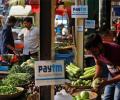
Paytm is banking on its offline network of merchants to fight bigger rivals Amazon and Flipkart

Apart from the growing adoption of the internet in the country, brands are drawn to the agility of the medium, its targeted and data driven approach and the increasing cost of offline channels for sales and distribution.

The high court had passed the restraining order after Ramdev claimed that the book had defamatory content.

FSN E-Commerce Ventures, the parent of Nykaa, has had a roller-coaster ride since listing last November. The initial public offering (IPO) was priced at Rs 1,125 apiece, and the stock listed at a 96 per cent premium, closing the first day at Rs 2,205 apiece. It subsequently hit a high of Rs 2,573 in late November, but has seen steady selling since, hitting a low of Rs 1,208 in May.

Their bootstrapped brand sold 25,000 units on Flipkart in five days during the 2017 festive sale.

After multiple attempts at selling itself, including to larger e-commerce player Snapdeal, ShopClues has found a buyer in Singapore-based e-commerce platform Qoo10 in an all-stock deal.
 © 2026 Rediff.com - Advertise with us - Disclaimer - Privacy Policy - Sitemap - Feedback - About us - Terms of use - Grievances